Independent China curtain-fabric sourcing. Specification-led inquiry. Not a mill storefront.

China fabric sourcing

Curtain Fabric Sourcing with Standard Textile

Buyers comparing home textile and upholstery cloth still need a curtain fabric article that can be quoted on the same usable width, the same GSM basis, and the same finish revision. Standard Textile keeps that comparison in a written brief. The desk does not weave cloth and does not present itself as the maker of any named range.

A useful opening record names fiber composition, construction, target mass, tolerance, cuttable width, and the retained swatch that color approval must match. A buyer may write, as cells rather than desk measurements: face 265 g/m² ±4%, lining 135 g/m² ±5%, sheer 78 g/m², ticket width 150 cm, usable width 142 cm, side hem 3 cm, fullness 2.2, repeat 32 cm, roll length 50 m, face yarn 20 tex, weft yarn 15 tex. Shade, handle, and lining behavior are checked against that record later, not against a verbal description of a showroom hanging.

Send a fabric brief
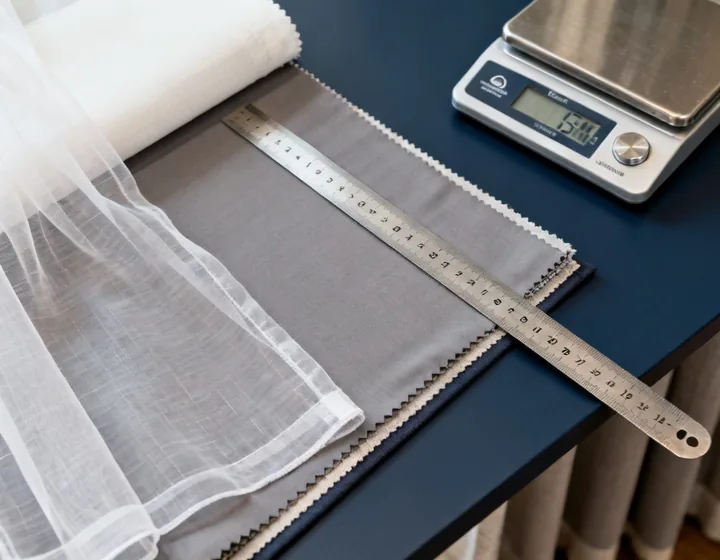
Curtain fabric swatches beside a width and GSM worksheet

Check the reference chain

Three identities have to stay attached to the same curtain fabric article. If any one of them changes, the earlier quotation stops being a like-for-like offer.

Keep changes visible

The sequence below is a handoff map. It is not a dated timetable. Each step closes when the open item is written down.

01 Clarify the brief

Record application, fiber composition, warp and weft or knit construction when it applies, GSM, usable width, finish, quantity unit, and destination. Shower curtain fabric and window drapery should not share one unfinished line just because both hang from a heading.

02 Compare suppliers

Normalize metre, kilogram, and roll prices only after usable width and defect rules match. A lower metre price on a narrower cuttable width can raise cutting loss. Incoterm and MOQ stay supplier-specific and are confirmed on that quote.

03 Approve the sample

Hang or table-review the swatch against the retained reference. Note handle, sheen, and whether a blackout layer is coated or laminated. Approval language should cite the revision, not a season name.

04 Agree bulk checks

Inspection coordination asks who applies the four-point inspection, on which lot, and against which defect limit. The desk can collect the plan. The selected supplier and the named professional party remain responsible for the test report.

Source within a defined scope

The live scope is Home Textile and Upholstery Fabrics, led by curtain fabric. Adjacent words such as sheer curtain fabric, blackout curtain fabric, curtain lining fabric, and shower curtain fabric stay inside that brief. This page does not open a general textile catalog.

Reference

Start from a known article or a physical sample. If the buyer is still choosing between cotton curtain fabric and polyester curtain fabric, that choice is a development question, not a bulk release.

Open the revision ledger

Options

Comparable constructions are listed for inquiry, then returned with supplier comments on width, mass, and finish. Browse the scope when you already know the family and need a card to start the message.

Browse the scope

Keep evidence scoped

Supplier certificates are request items. They are not credentials of this desk. A report counts only when the entity, the article, the date, and the relevant lot are visible.

Sample record

Material and version identity include the face, the lining if it is a separate cloth, and the color reference. Colorfastness and dimensional stability are named here only when the buyer has already chosen a test method and a sample condition.

Inspection brief

Lot, method, and acceptance agreement travel with the shipment file. A retained swatch can show target handle. It does not replace an agreed sampling plan on the bulk rolls.

An approved swatch and a bulk lot answer different questions. The swatch fixes appearance and hand. The lot check applies the written defect rules, roll length notes, and any shade-band limit. Treating the swatch as a blanket pass is the usual point where later claims start.

Frame the application

Supplier matching starts from product use. A living-room drapery, a cubicle curtain fabric, a theater curtain fabric, and a shower curtain fabric do not share one exposure story. Lightfastness, wash stability, and flame-related paperwork each need the method and the market written into the brief.

Upholstery cloth can sit in the same category name, but it is a separate construction question. Abrasion resistance matters more on seating than on a sheer. Do not copy a seating specification onto a window cloth without saying so.

Review application notes

Before you ask for a price

These answers are desk practice for curtain fabric. They are not universal pass values.

What should the buyer attach as the color reference at Standard Textile?

The reference is the lab dip or retained swatch that both sides can still identify, plus the revision mark. A photograph of a hanging is a clue. It is not the approval unless the buyer writes that it is.

How should quotations be compared?

Line up fiber composition, construction, GSM, usable width, finish, quantity unit, and Incoterm. Then compare price. A quote that omits cuttable width is parked until the supplier fills that cell.

Who performs testing and inspection?

The buyer names the method and the party. The selected supplier provides article-level documents. Standard Textile coordinates the request and the file. It does not issue the certificate.

Send the reference and the requirement

State the curtain fabric, the quantity unit, and the destination. Terms are confirmed per supplier and per order.

Send a fabric brief